Composer · Rome

Roberto
Rosi

More than forty years of music for picture. And a line of research that has never been interrupted: sound as matter.

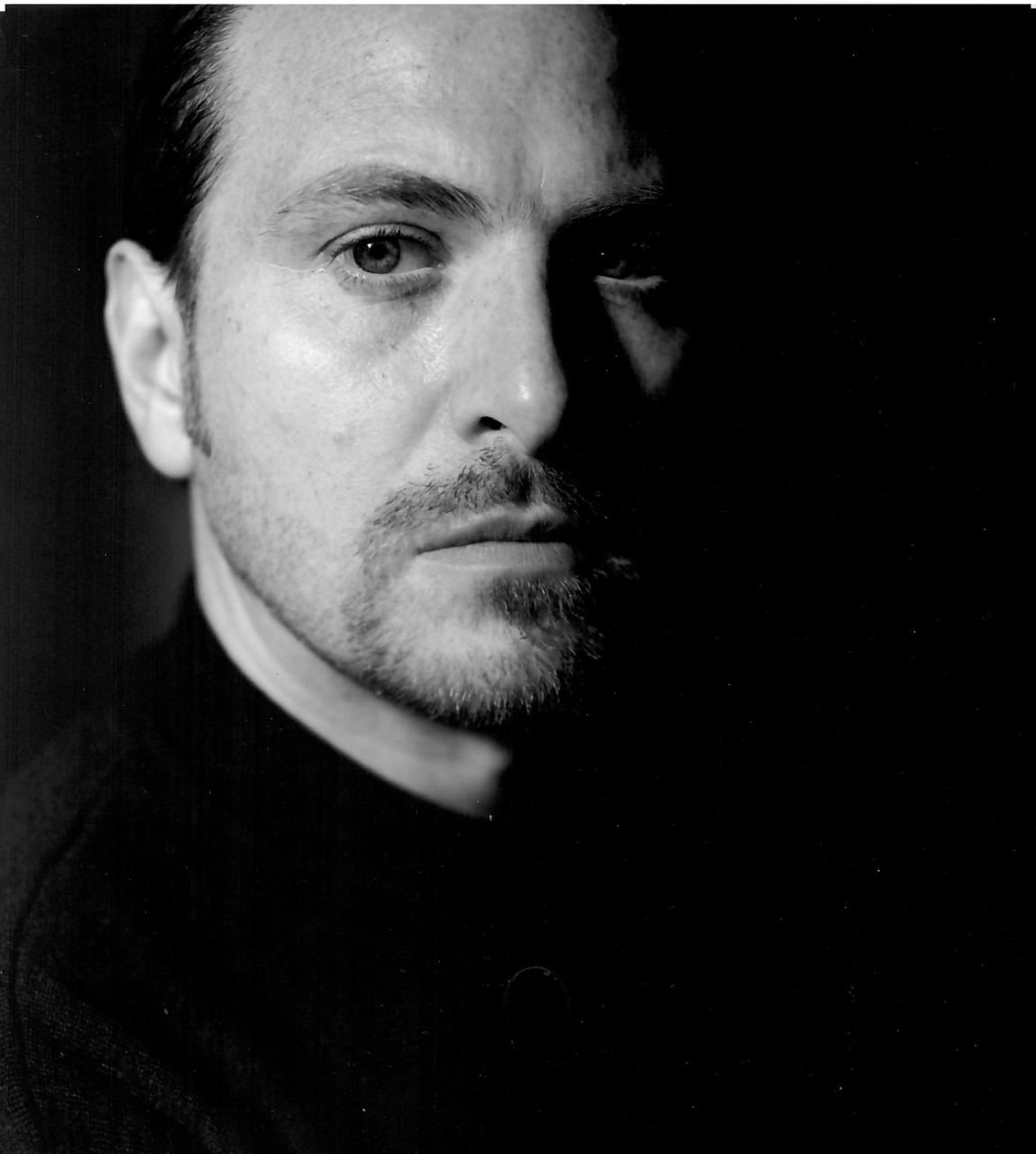
Black-and-white portrait of Roberto Rosi, half of his face in shadow

Biography

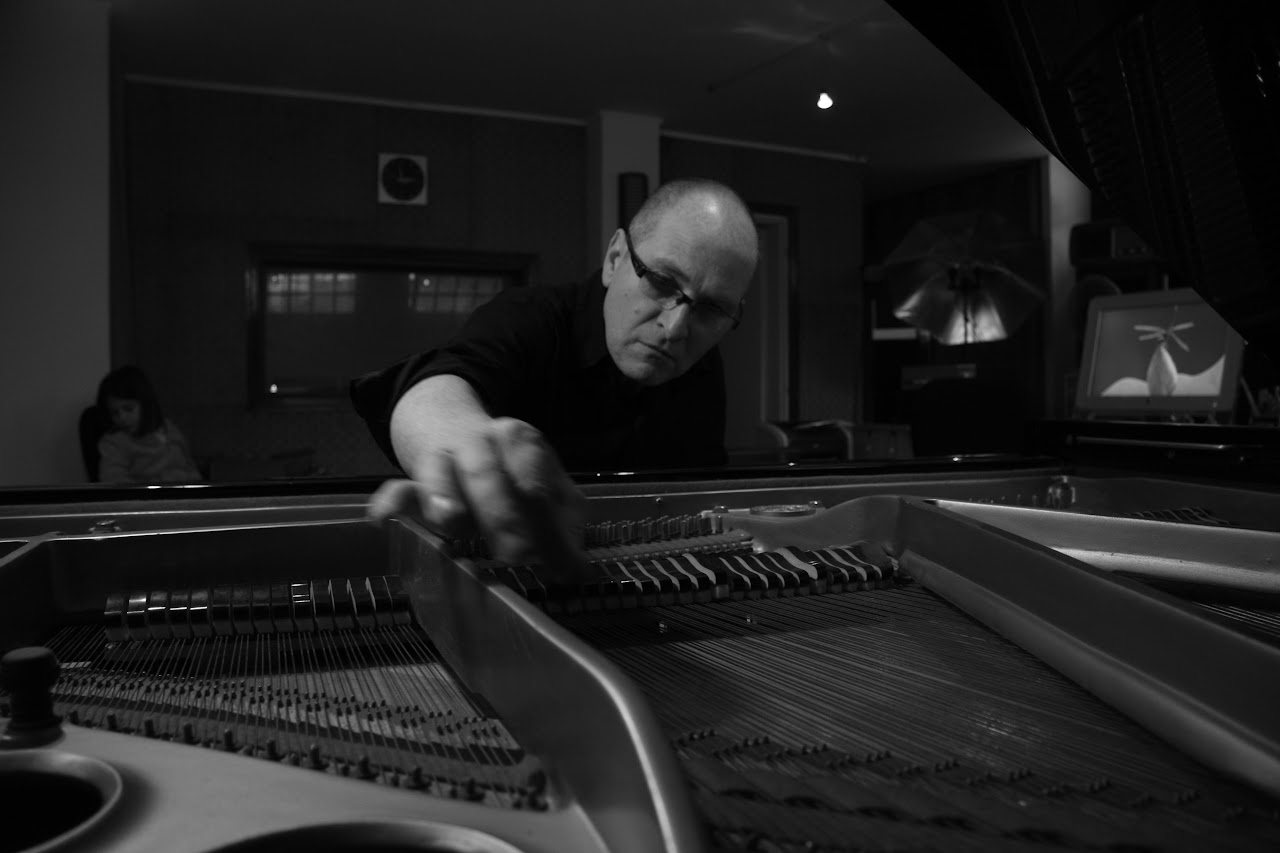
Roberto Rosi playing inside an open piano

Roberto Rosi (Rome, 1959) is a composer and multi-instrumentalist. His training, which took shape between the late 1970s and the early 1980s at the Conservatorio di Santa Cecilia in Rome, where he studied Composition, Piano, Clarinet, Saxophone, Percussion Instruments and Musical Phonology, belongs to a period of profound renewal in Italian contemporary music. It was in the Musical Phonology course that he developed his conception of sound as malleable matter and learned the analogue techniques of recording and manipulating sound on magnetic tape.

Read the full biographyClose

While still a student, in 1979 he signed his first contract with RAI for the programme Un certo discorso (RAI Radio3), for which, in every episode, he composed and performed live musical interventions in counterpoint to the monologues of the actor Francesco Vairano. These early pieces already reveal his interest in experimentation and in sound understood as matter to be explored through unconventional performance practices: he played the soprano saxophone inside the open piano, letting its strings resonate sympathetically, and drew indeterminate sounds from the structural parts of the saxophone and the piano.

His work as a composer of music for picture began in 1982, at the age of 23, when Lodolofilm entrusted him with writing the music for RAI television title sequences and for advertising campaigns produced by the company.

Between the late 1970s and the 1980s he took an active part in the season of musical experimentation in Rome, combining compositional research with instrumental practice. He attended the workshops of Domenico Guaccero and his Nuova Didattica della Composizione, and joined, as clarinettist and percussionist, Nuove Forme Sonore, an ensemble founded by Giancarlo Schiaffini and conducted by the Bolivian composer Edgar Alandia, with which he performed in concert and recorded, taking part in the recordings released by Edipan in 1986 and 1990. In the mid-1980s he began his research into sound drawn from matter made form, bringing to the concert stage with Nova Percussio his own compositions for percussion and magnetic tape, in which recorded sounds foreign to codified, tempered musical systems contaminate and enrich the sonorities of traditional instruments.

In 1994, thanks to the possibilities opened up by the first sound-editing software, Rosi developed a line of research on the human voice through the fragmentation of recorded sound, exploring the sonic and expressive qualities that persist beyond the intelligibility and meaning of the word. From this research came Tataush, a CD released in France by Arcosudfilms.

In the field of music for picture, over the course of his professional life he has composed for the leading advertising agencies and for brands such as Esso, Telecom, TIM, Chiquita, Tuborg and Martini. For Edizioni Musicali Rai Trade he has also released a series of CDs containing a considerable number of his compositions, which became a permanent part of the RAI repertoire, making him over the years one of the most widely used authors in radio and television productions.

Over more than forty years of compositional activity, his experimentation has turned progressively towards the deep roots of music, isolating its most essential and primordial elements: sonic matter, vibration, gesture, and the sonorities that precede or go beyond codified, tempered musical systems. It is a path that, in his artistic maturity, finds its own definition in the concept of Musica Primordiale, a term he coined, whose principles are formulated and explored in the book L'Eco della Forma. Manifesto della Musica Primordiale (2026).

With the world premiere of L'Eco della Forma (The Echo of Form), presented at SALA1, Centro Internazionale d'Arte Contemporanea in Rome, this research finds its full artistic expression, without, however, constituting a point of arrival. For Rosi, Musica Primordiale remains an open and fertile territory of research and of new compositional possibilities, destined to develop further and, at the same time, to go on nourishing his music for picture, in a process of mutual contamination from which both languages draw new material and new expressive vitality.
Musica Primordiale

to make evident the evidence of matter made form

from the “Manifesto della Musica Primordiale”, forthcoming

Musica Primordiale is a way of composing built exclusively from sounds extracted from matter made form: sculptures, architecture, stones, metals, woods, everything to which nature or man has given form without thinking of sound. No musical instrument, no scale, no synthesised sound: only the frequencies that every form has held for as long as it has existed, awakened by a gesture that remains visible, because the gesture is part of the work.

The full conceptClose

It is not an invention: it is a recognition. This music has always existed – it is the first gesture of every child who strikes an object to hear it answer – but it had never been separated from everything else, observed in its autonomy, delimited. The term, its boundaries and its rules were isolated and set down by Roberto Rosi in the book “L'Eco della Forma. Manifesto della Musica Primordiale”.

What distinguishes this practice from every poetics of the twentieth century is not the use of non-instrumental sounds: it is its purpose. Here the relationship between music and the world is reversed:

“This music does not make use of forms: it serves them.”

Its primary task is to make evident the evidence of matter made form: to exalt it, to illuminate those parts of it that would remain in shadow to one of our senses, to celebrate it before those who look and listen. The Manifesto makes this a rule of conduct: the extraction of sounds and their ordering in time must be “an act of humility, carried out in the service of exalting the sculpture; any temptation to exalt the abilities of the composer or the performer excluded”.

There is, in this, a consequence that concerns anyone who gives form to matter. Whoever chooses a mass, a thickness, a void, a point of support is also making, without needing to think about it, choices of sound. In the words of the Manifesto:

“This music does not simply tell the sculptor that his work produces an interesting sound: it tells him that his plastic decisions also have sonic consequences. [...] Then the composer arrives, and explores them.”

And what that exploration gives back is not ornament, but knowledge:

“Sound allows the beholder to weigh matter without touching it: to grasp its consistency, its density, its weight. Before a metal sculpture with a hollow-shell construction, that is, empty inside, sight alone does not reveal whether the body is solid or hollow; its voice is enough, and the structure declares itself.”

For this reason, in Musica Primordiale, the order of things is fixed once and for all: first comes knowledge, then, if at all, composition. Matter is not interrogated because a sound is needed; it is interrogated in order to be listened to. The forms are set into vibration by gentle, agreed means – the hands, soft sticks, the hair of a bow – and nothing is added, nothing altered.

The first work officially to bear this name is L'Eco della Forma, composed solely with the sounds of Tito Amodei's sculptures and presented at Sala 1, at the Scala Santa in Rome, in the centenary of the sculptor's birth: for the duration of the work, Amodei's sculptures were perceived in a dimension that sight alone, in sixty years, had never revealed. And the Manifesto entrusts a precise image to the future: a form, once its sonic vocation has been brought to light, can become “a unique and unrepeatable instrument, for which one writes”.

“What we call music is born of the awareness of a dormant sound held within all matter made form, and of the primordial need to awaken it for the sheer pleasure of listening to it.”

L'Eco
della Forma

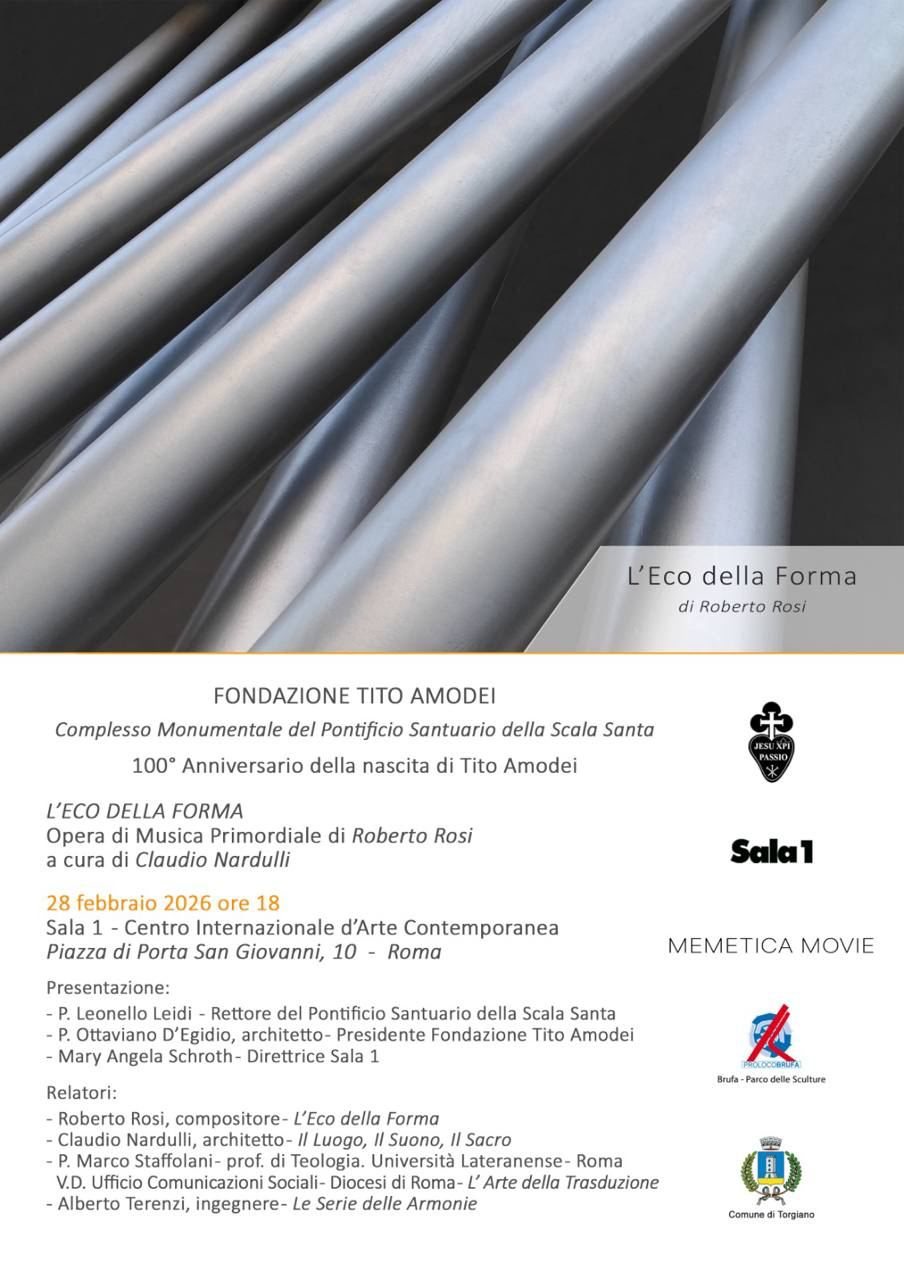
World premiere 28 February 2026 Sala 1, Centro Internazionale d'Arte Contemporanea, Rome

“When matter becomes form it inevitably holds a dormant sound of its own, waiting to be awakened.”

The event on Exibart

The invitation video

One minute to enter the work

This is the excerpt that Sala 1, the Centro Internazionale d'Arte Contemporanea, chose to send to its contacts as an invitation to the premiere on 28 February. An audiovisual work this original could not be explained in words: it had to be seen and heard, if only for a minute. It was a crucial decision on the part of Sala 1 and its curator, Mary Angela Schroth, and it proved a winning one: twice as many people came to the screening as the hall could hold.

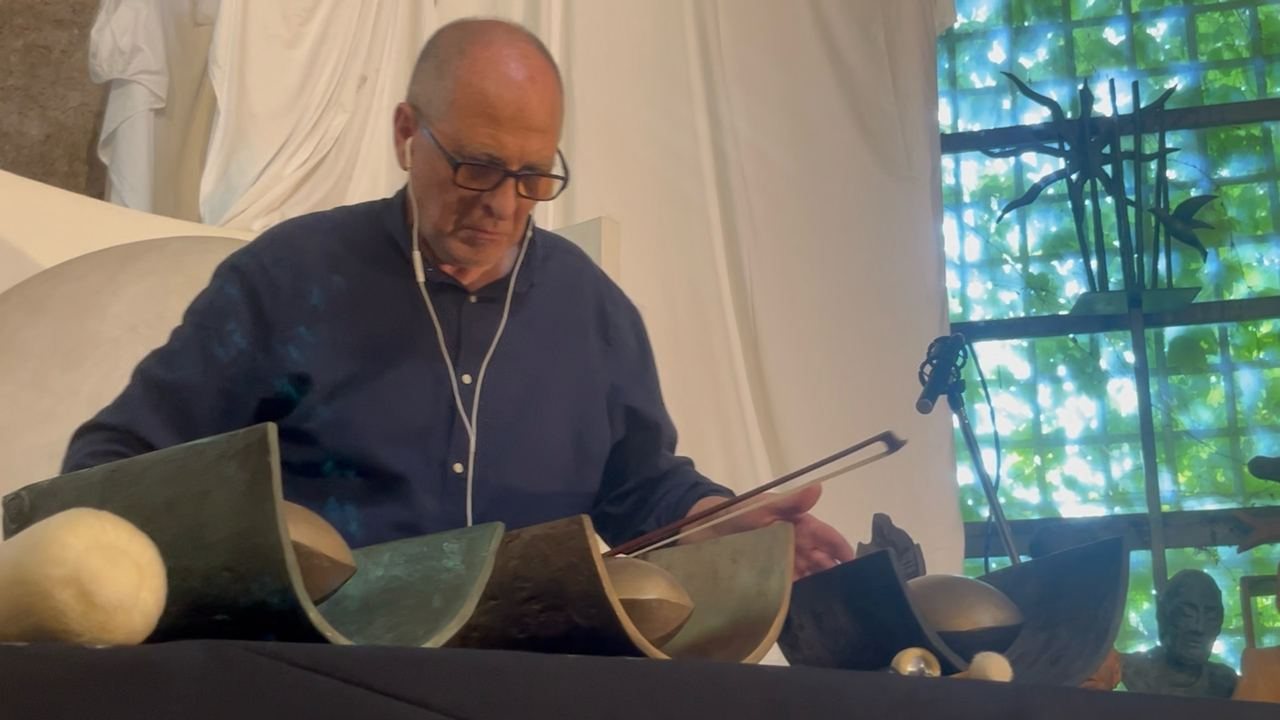
The video offers a brief glimpse of the first part, with its powerful rhythm, devoted to Tito Amodei's wooden sculptures, the long shafts that the sculptor worked with nothing but an axe. Then the long sounds of bronze set vibrating with a violin bow, rich in shifting, hypnotic overtones.

This is an excerpt: the full work is below

The full work

L'Eco della Forma, exactly as it was screened at Sala 1 on 28 February 2026.

The video is hosted by YouTube. Until you click, the page does not contact Google; once you start it, YouTube receives browsing data in accordance with its privacy policy (details). Watch it on YouTube.

Poster for the world premiere of L'Eco della Forma, 28 February 2026
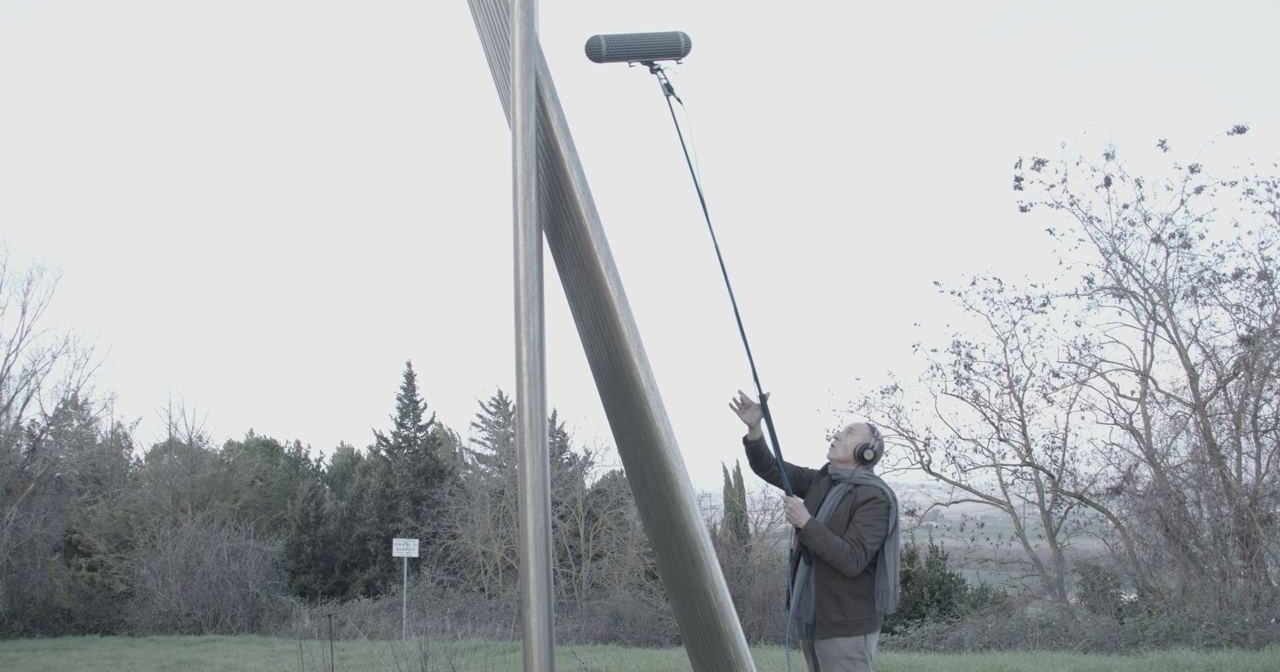
Roberto Rosi, with headphones and a microphone on a stand, records the sound of a steel sculpture outdoors
Roberto Rosi captures the sounds that the wind awakens in Tito Amodei's sculpture “Vibrazioni”, at the Parco delle Sculture di Brufa (Perugia).

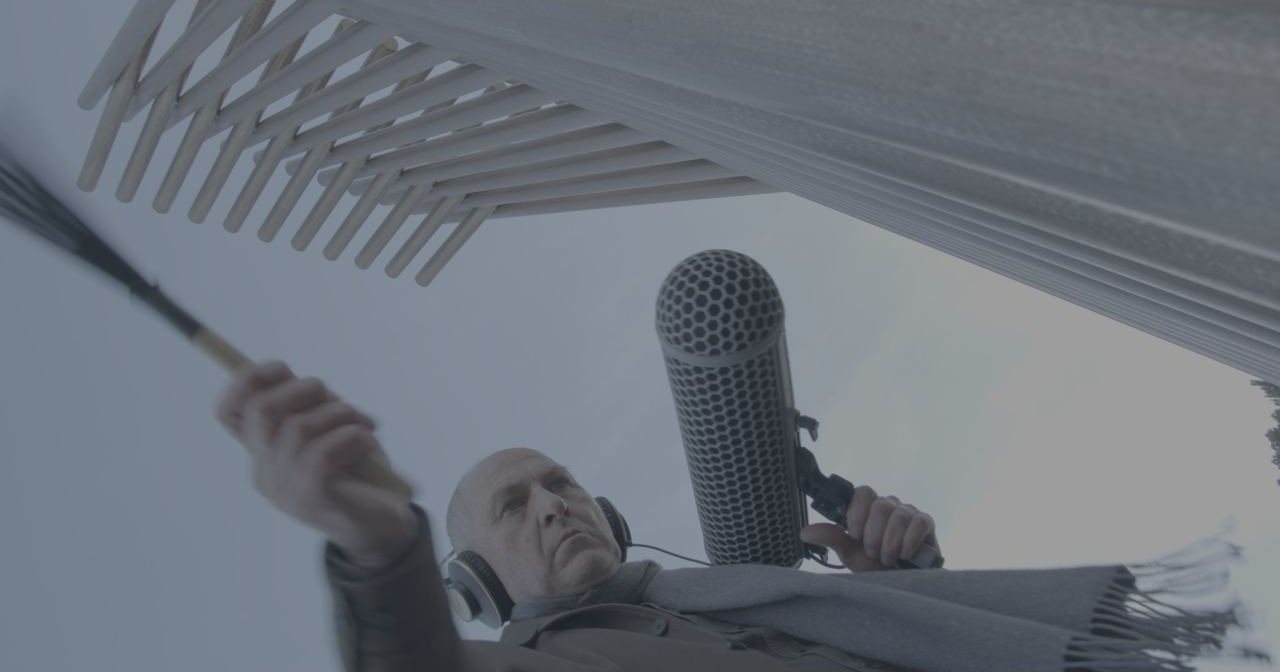
No instruments, no tempered scale: the frequencies are those that metal, bronze and stone hold within them, awakened with the bow, brushes and hands, and captured by the microphone at close range. The image enters the composition as an element in its own right: one sees the gesture that produces the sound.

L'Eco della Forma: a work of Musica Primordiale, the territory of research to which Roberto Rosi gives its name and its principles in the book L'Eco della Forma. Manifesto della Musica Primordiale.

Édité en France

1994 – The Paris years

1994 – 2000 · Arcosud-Films · FNAC

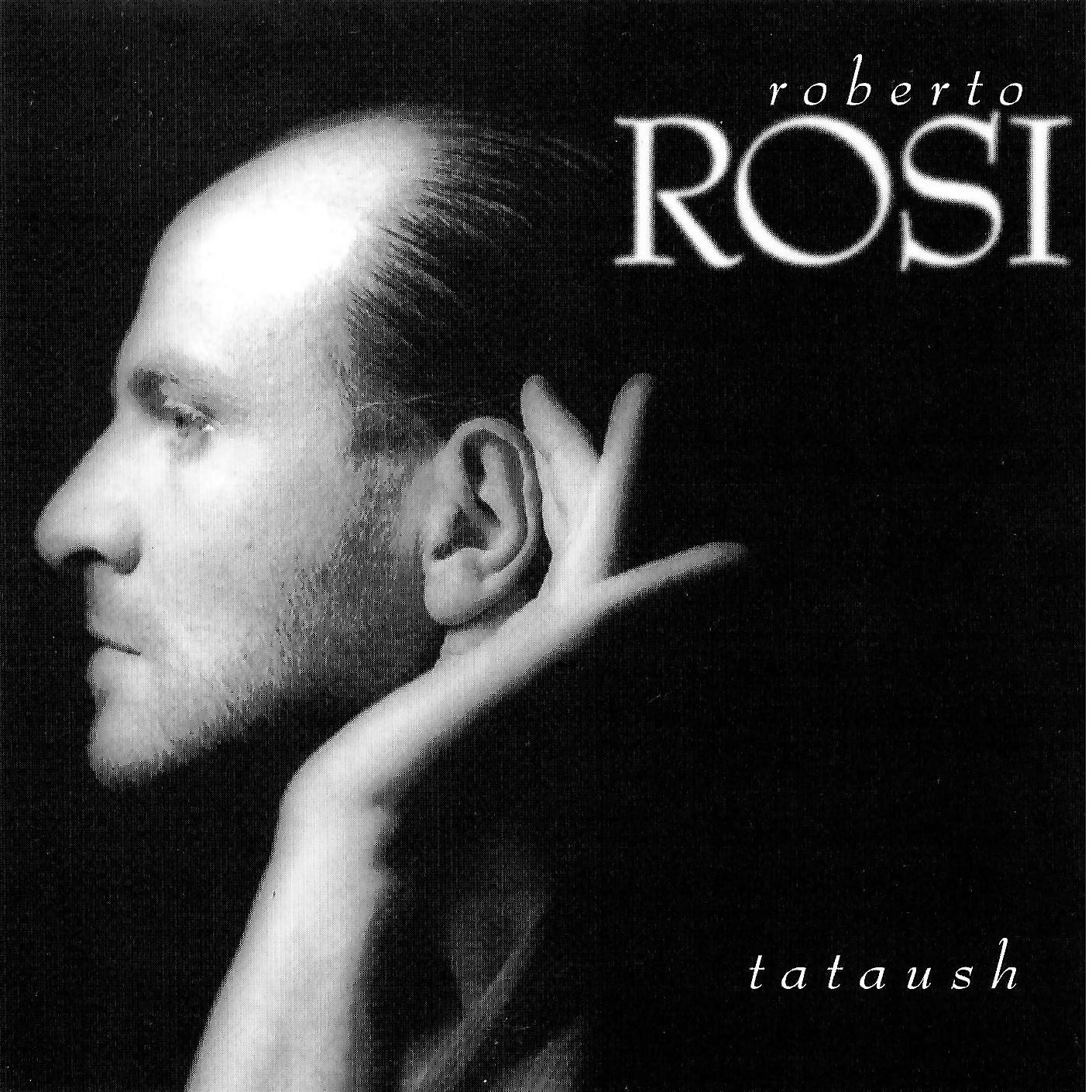
Cover of the CD Tataush by Roberto Rosi
Arcosudfilms, France

Tataush 1994 CD

In 1994, thanks to the possibilities opened up by the first sound-editing software, Rosi developed a line of research on the human voice through the fragmentation of recorded sound, exploring the sonic and expressive qualities that persist beyond the intelligibility and meaning of the word. From this research came Tataush, a CD released in France by Arcosudfilms.

The text printed on the CD cover

In my life I have written and directed an inordinate number of films. They were never shot, but my brain nonetheless believed it saw their frames persist on the retina of my eyes. The only tangible proof left are the soundtracks contained on this CD.

Unlike the music of the films we see on the big screen, these compositions do not bring the same images to mind for everyone. Here each listener will have the surprise of coming upon scenes produced, self-sufficiently, by their own capacity to imagine. Truer than real ones, which, at the very moment we perceive them, already no longer exist.

If you wish, while you listen to this CD, close your eyes and watch. A piece of advice: do not try to describe what your imagination will have managed to give you. Everything would be trivialised: my work, your sensibility.

Roberto Rosi '94

Composition, direction and production: Roberto Rosi

Voice on Uja
Demetrio Stratos, courtesy of Cramps Records
Cover of the CD Credo, Enfants d'Abraham
Arcosud-Films / FNAC, France

Credo 2000 CD

Composition, direction and production: Roberto Rosi

Music for advertising

A selection of jingles and TV themes with music by Roberto Rosi.
  • Rai
  • Esso
  • Agip
  • Ford
  • Nissan
  • Martini
  • Tuborg
  • Keglevich
  • Golia
  • Condorelli
  • Chiquita
  • Clearblue
  • Latte Arborea
  • Nice
  • Cherubini e Dannati
  • Telecom Italia
  • TIM
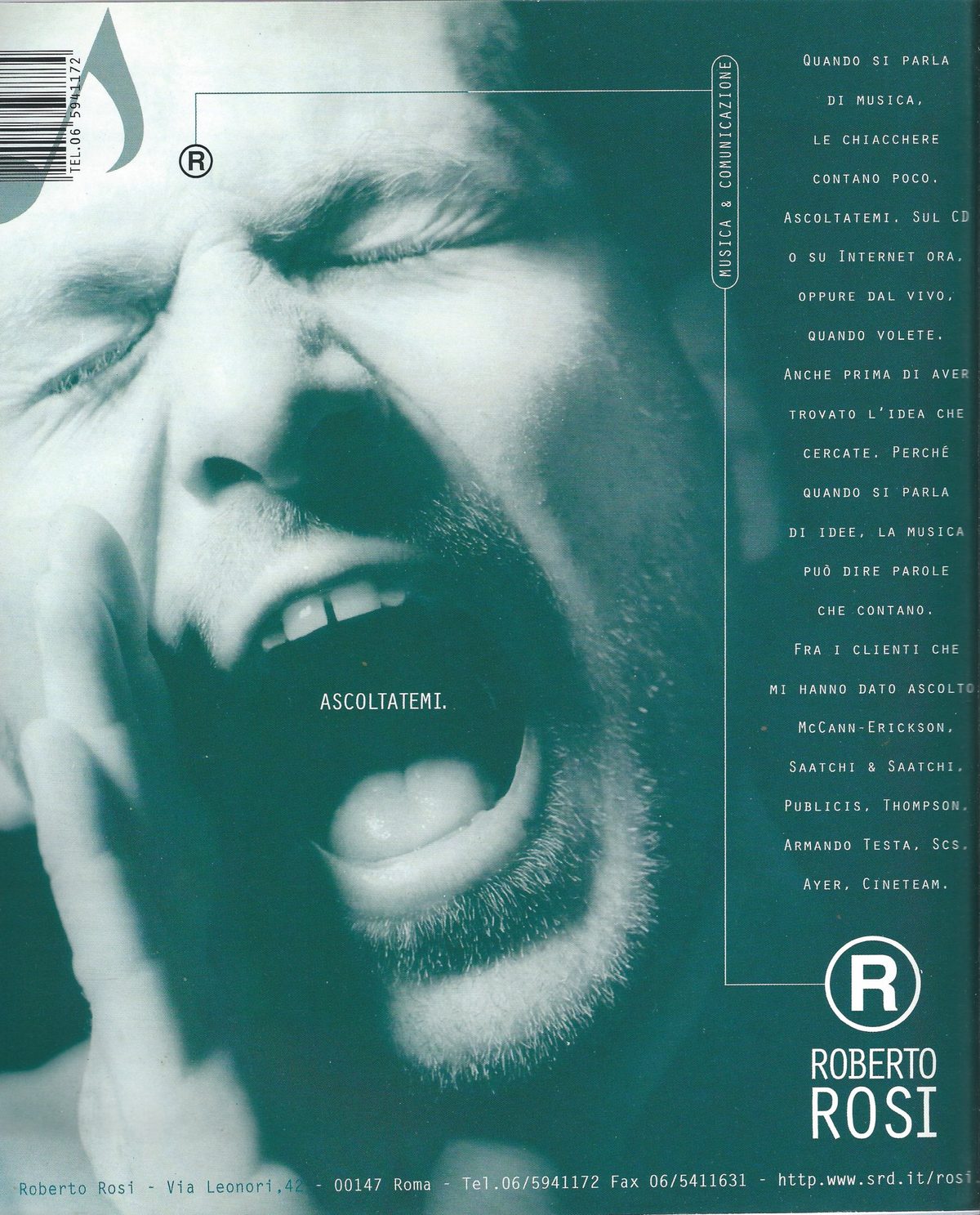
1994 Roberto Rosi’s advertising page “Ascoltatemi”, Musica & Comunicazione
Published in Agendo in 1994

From the archive · Agendo, 1994

The page urged agency creatives to consult the composer even before they had found the final idea: when it comes to ideas, music can say words that count.

Since 1982, when Lodolofilm entrusted him with the music for RAI television title sequences and advertising campaigns, Roberto Rosi has composed for the leading Italian and international agencies. His research into sonic matter does not stay outside the recording studio: it contaminates the craft and gives it a signature recognisable even in thirty seconds.

Agencies he has worked with

  • McCann-Erickson
  • SCS
  • Ayer
  • Cineteam
  • Lodolofilm

Rai – Rai Trade –
Edizioni Musicali

Music for picture

Cover of the CD Soft Guitar, Rai Trade
Soft GuitarCD · 2001
Cover of the CD Frammenti d'orchestra, Rai Trade RTCD 178
Frammenti d'orchestraCD · 2002
Cover of the CD Frammenti, Rai Trade RTCD 146
FrammentiCD · 2003
Cover of the CD Frammenti II, Rai Trade RTCD 165
Frammenti IICD · 2003

On vinyl

Cover of the LP Curl by Roberto Rosi
CurlLP · 1987
Cover of the LP Gleeman
GleemanLP · 1988
Cover of the LP Yo-yoando
Yo-yoandoLP · 1989

Composition, direction and production: Roberto Rosi

Since 1979

From the very beginning:
research and music for picture

From his years at the Conservatory, Roberto Rosi's career took two parallel paths, and he pursues them together to this day: on the one hand research into sound, on the other music for picture.

Research

1979 Radio Rai Un certo discorso

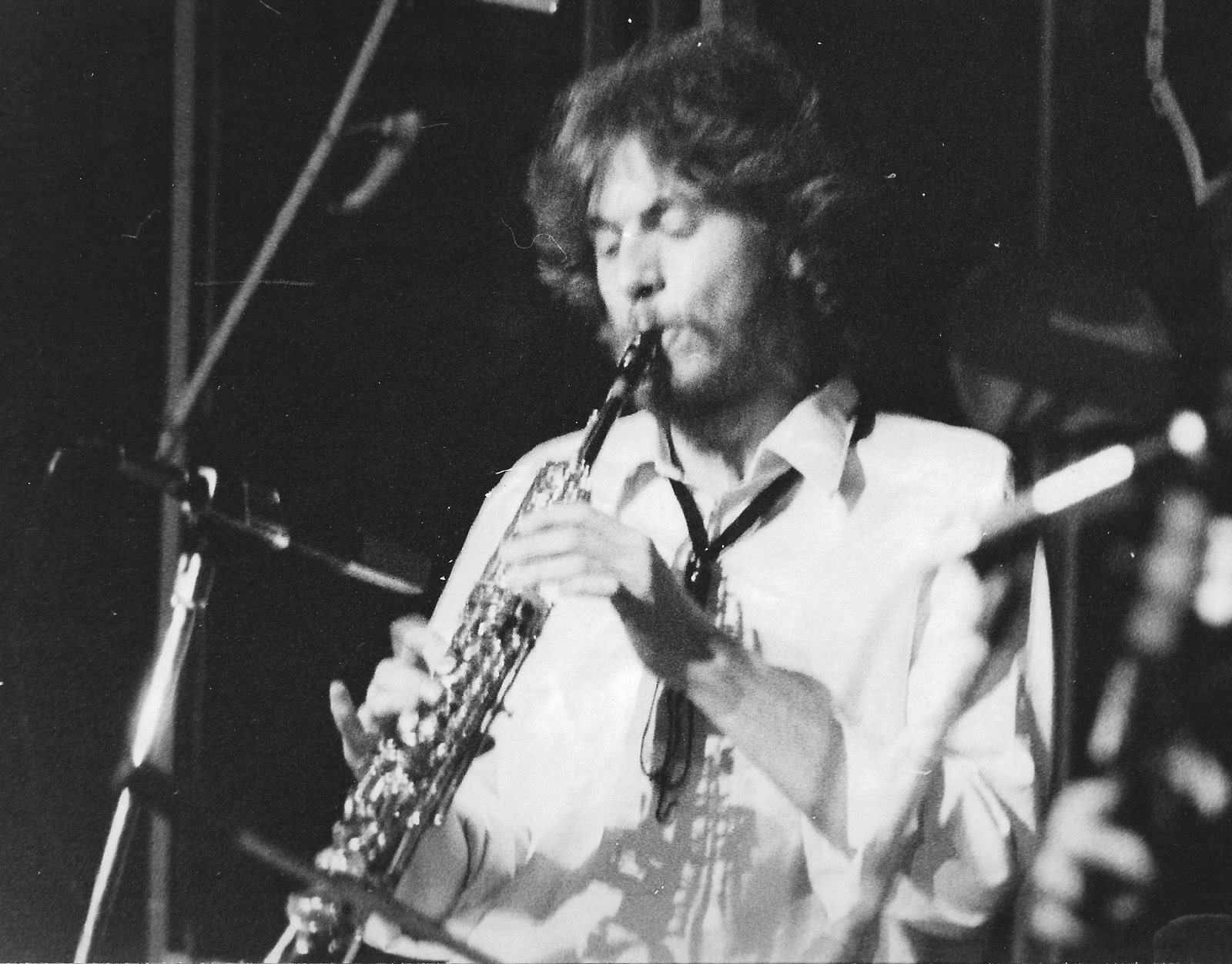
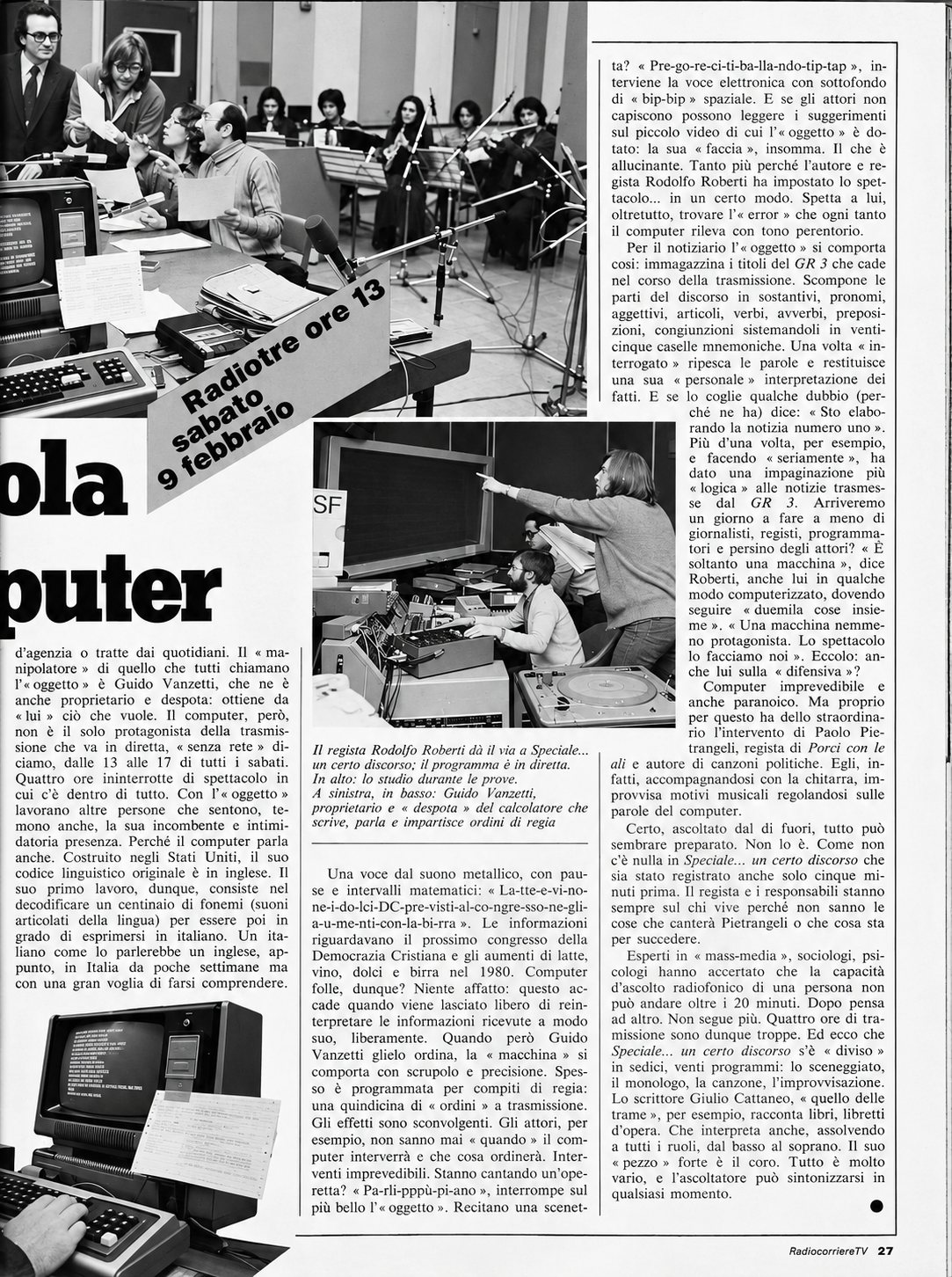
First contract with Rai, for Radio3: in every episode he composed and performed live experimental musical interventions in counterpoint to the monologues of the actor Francesco Vairano. He played the soprano saxophone inside the open piano, letting its strings resonate sympathetically.
Roberto Rosi on soprano saxophone in 1979
1979 · Roberto Rosi on soprano saxophone in the Rai studios
Cutting from Radiocorriere TV, 1979, on the programme Un certo discorso
Radiocorriere TV, 1979: the programme in the studio, Roberto Rosi on clarinet with the group

1986 · 1990 Nuove Forme Sonore

Clarinettist and percussionist in the ensemble founded by Giancarlo Schiaffini and conducted by Edgar Alandia, with which he recorded for Edipan.
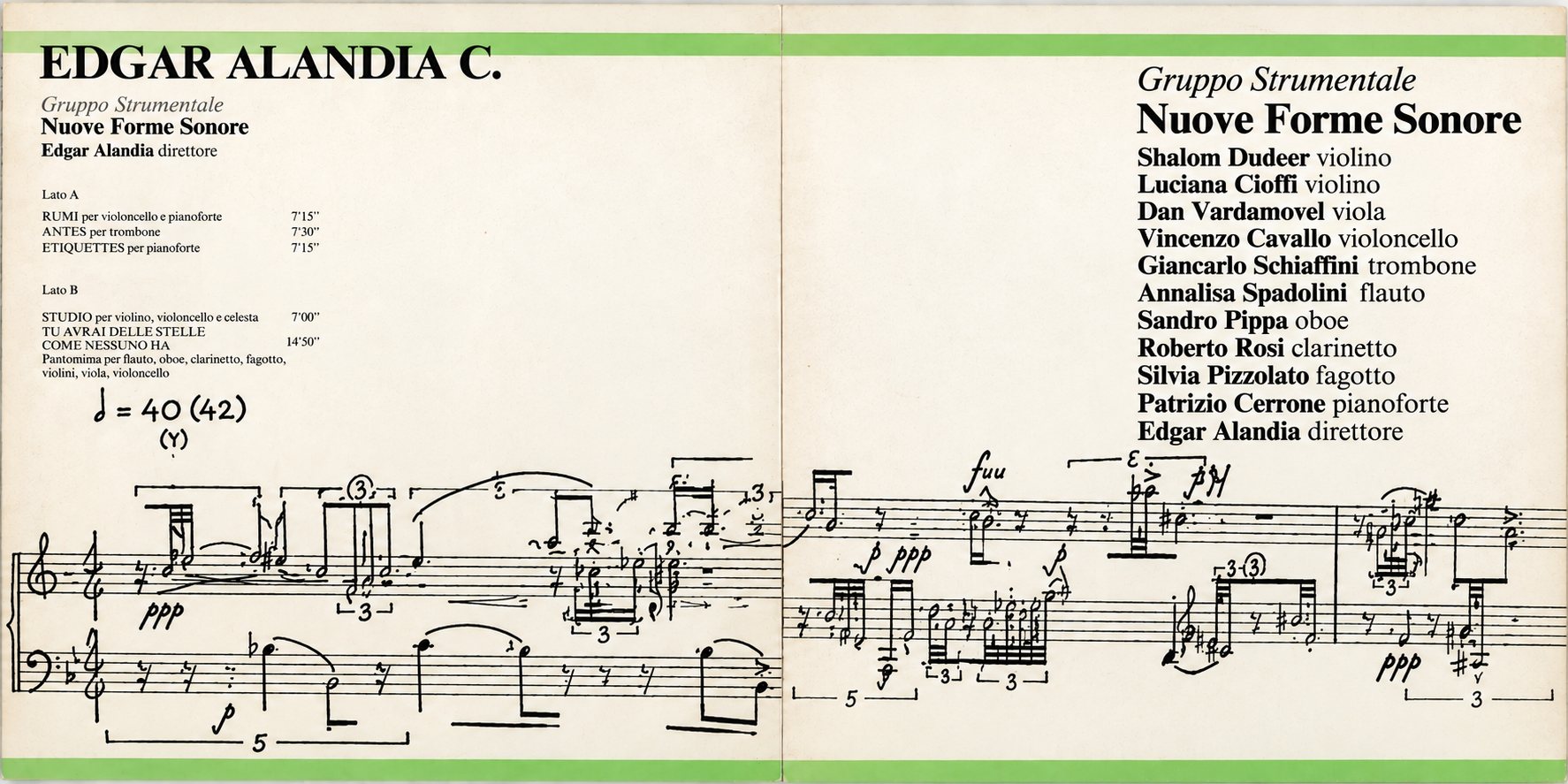
Record by Edgar Alandia with the Gruppo Strumentale Nuove Forme Sonore: among the performers, Roberto Rosi on clarinet
The record by Edgar Alandia with the Gruppo Strumentale Nuove Forme Sonore

1980s · 1990 Nova Percussio

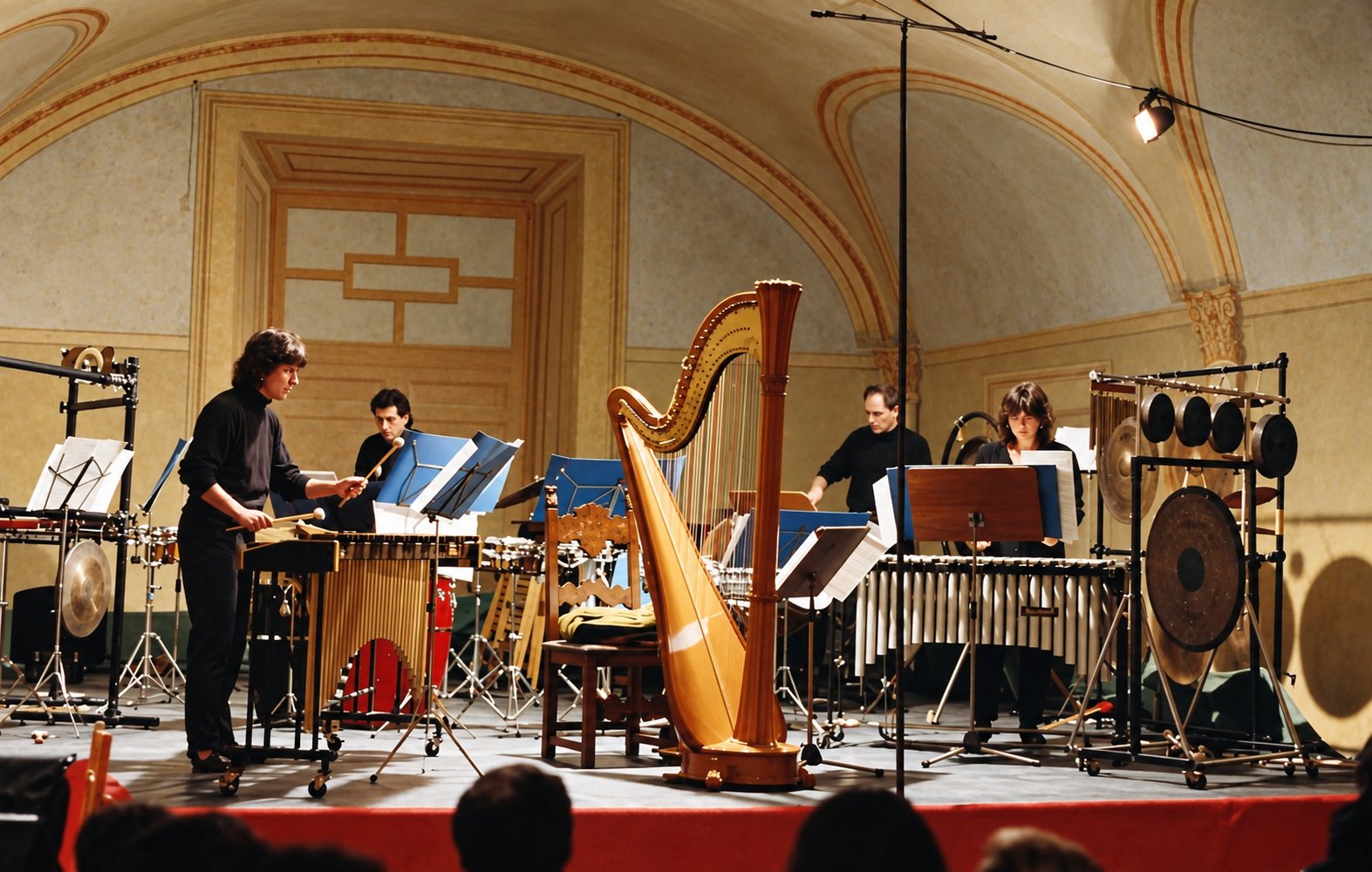
From the mid-1980s he brought to the concert stage, with Nova Percussio, compositions for percussion and magnetic tape, in which recorded sounds foreign to codified musical systems contaminate the traditional instruments.

Nova Percussio in concert at Palazzo Rospigliosi, Zagarolo: percussion and harp beneath a frescoed vault
Nova Percussio in concert, Palazzo Rospigliosi, Zagarolo
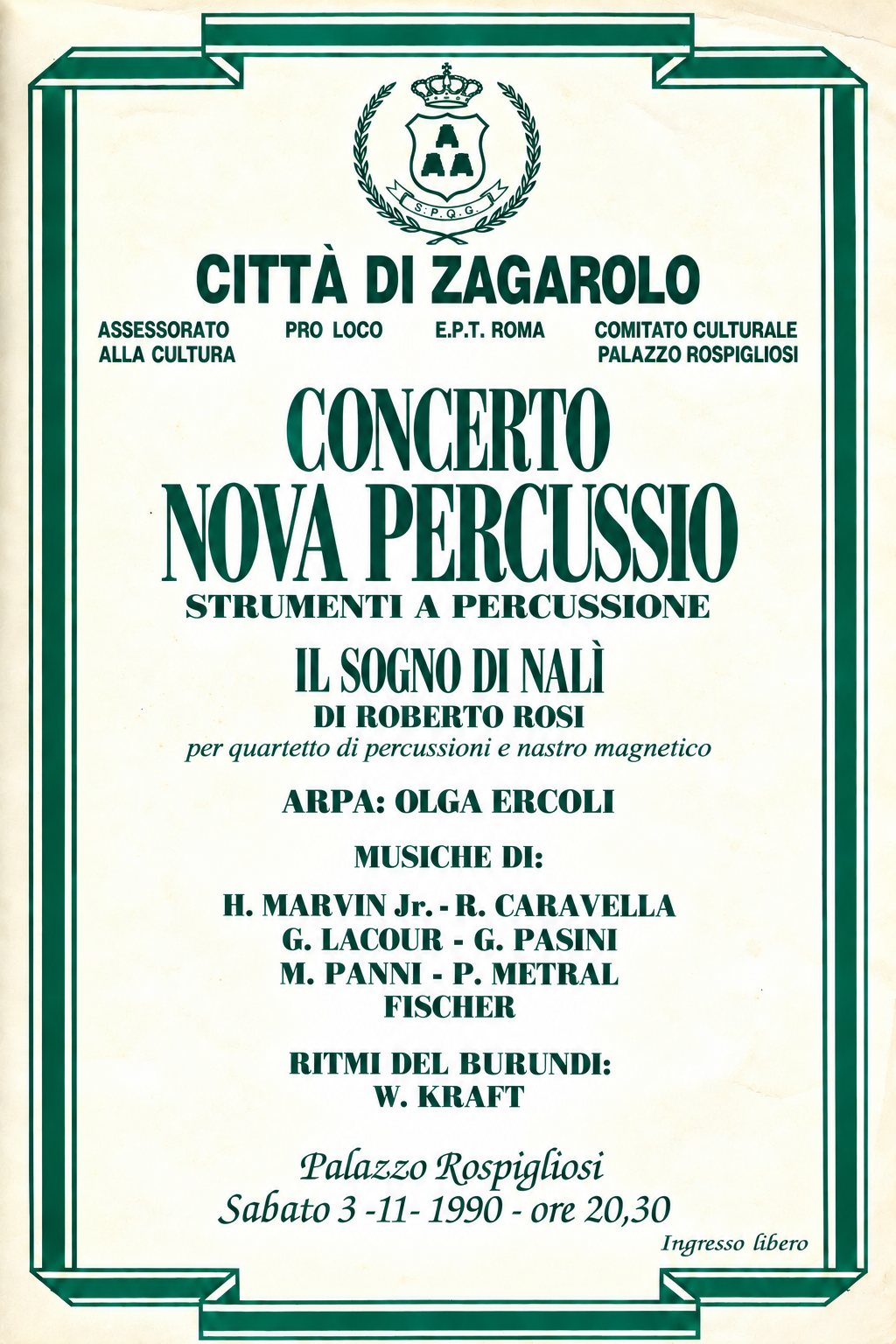
Poster for the Nova Percussio concert at Palazzo Rospigliosi, Zagarolo, 3 November 1990, with Il sogno di Nalì by Roberto Rosi
The poster: Il sogno di Nalì, for percussion quartet and magnetic tape, 3 November 1990

Music for picture

1982 Lodolofilm

At the age of 23 he was entrusted by Lodolofilm with the music for Rai television title sequences and advertising campaigns.

Then Advertising

The leading Italian and international agencies, brands such as Esso, Telecom, TIM, Chiquita, Tuborg and Martini. Watch the showreel.

Then The Rai Trade releases

A series of CDs whose compositions became a permanent part of the Rai repertoire. The covers.

Research today L'Eco della Forma Musica Primordiale in its purest form

From the historical archive

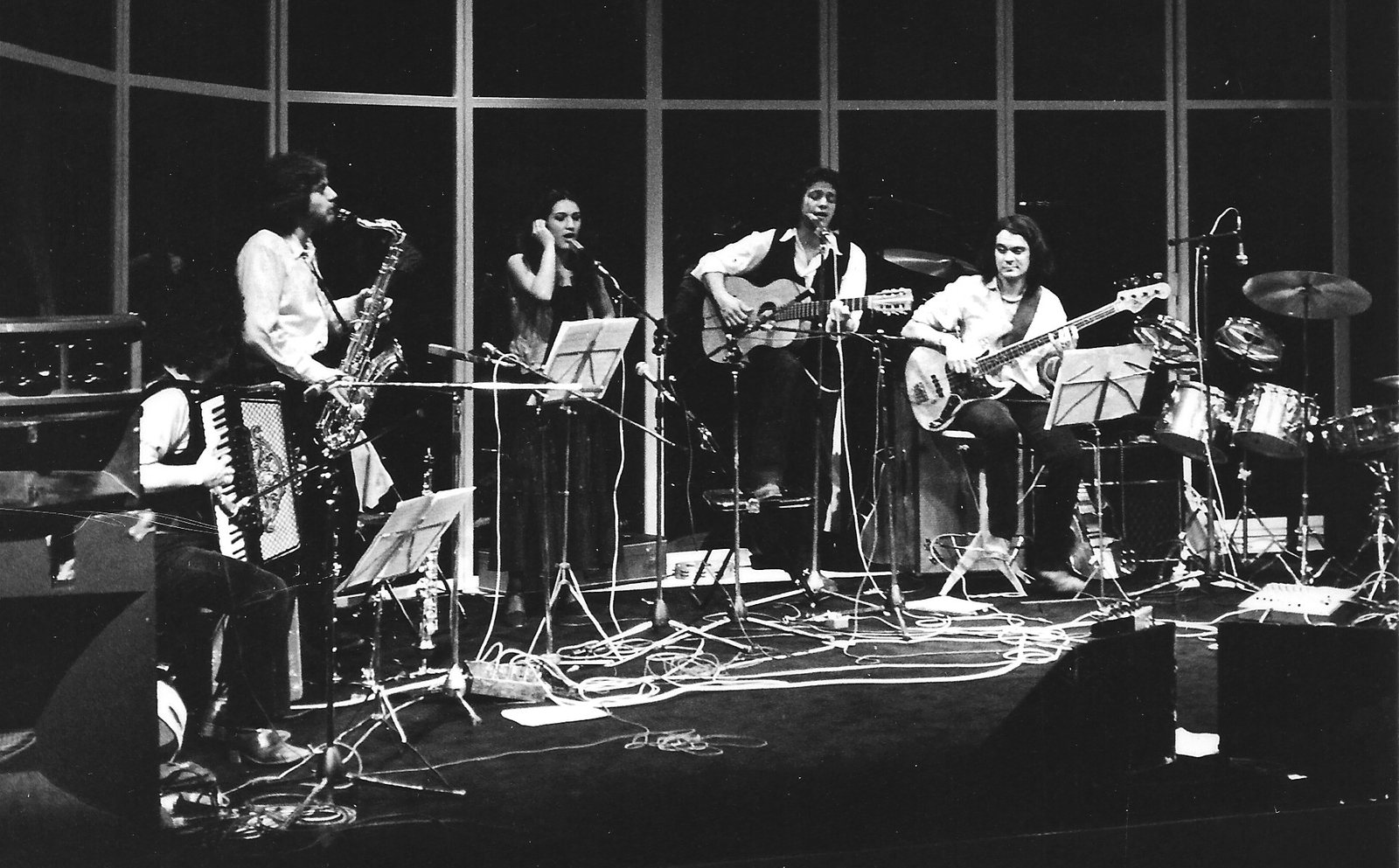
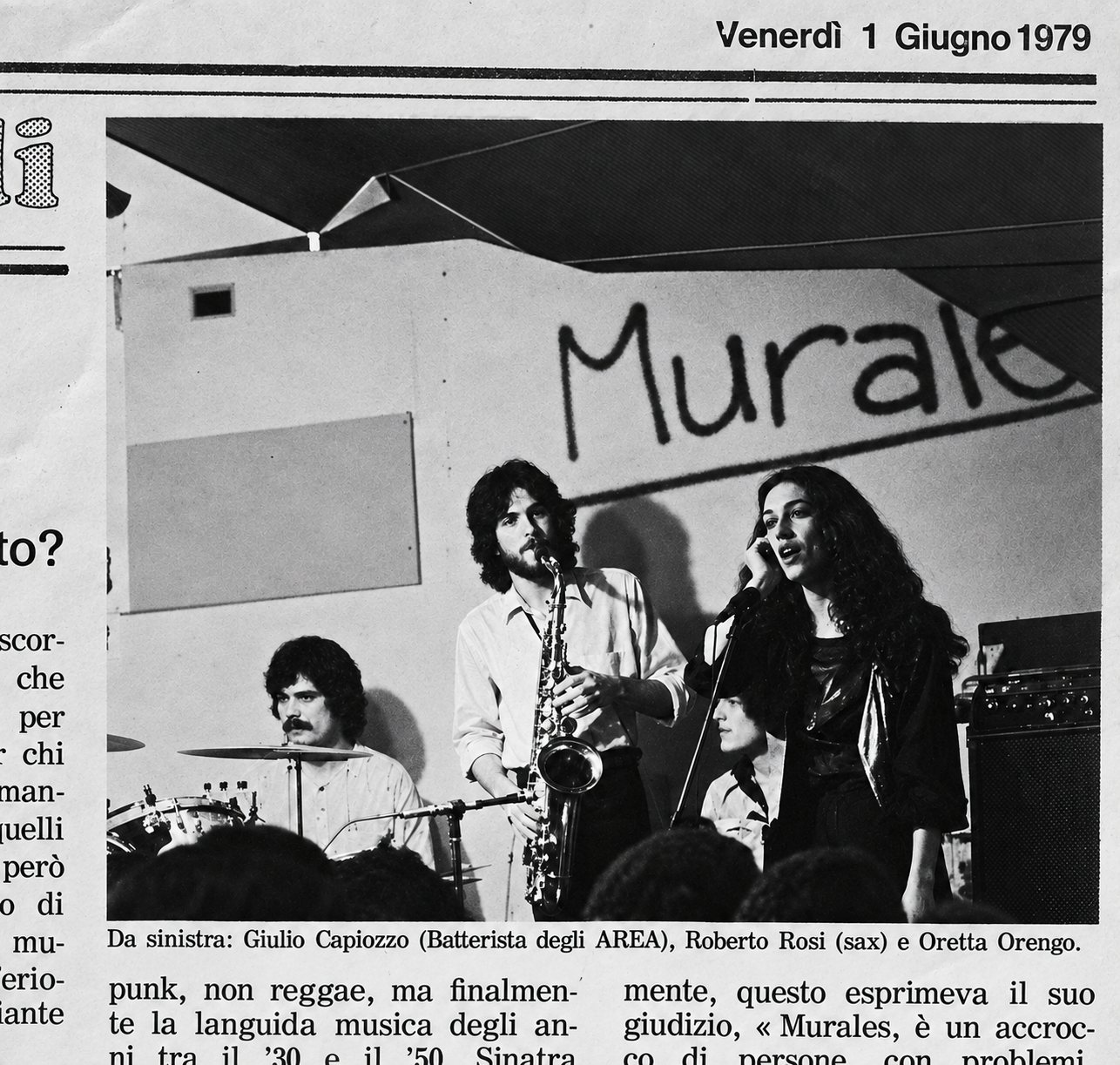
In the late 1970s, during his classical studies at the Conservatory, a brief experience in progressive rock, alongside leading figures of that scene

Among them Giulio Capiozzo, drummer of Area, the defining band of those years, as the newspaper cutting of 1 June 1979 shows.

Il Carro della Fortuna in concert at the Teatro Alberico in Rome in 1979, Roberto Rosi on saxophone
Il Carro della Fortuna at the Teatro Alberico, Rome, 1979
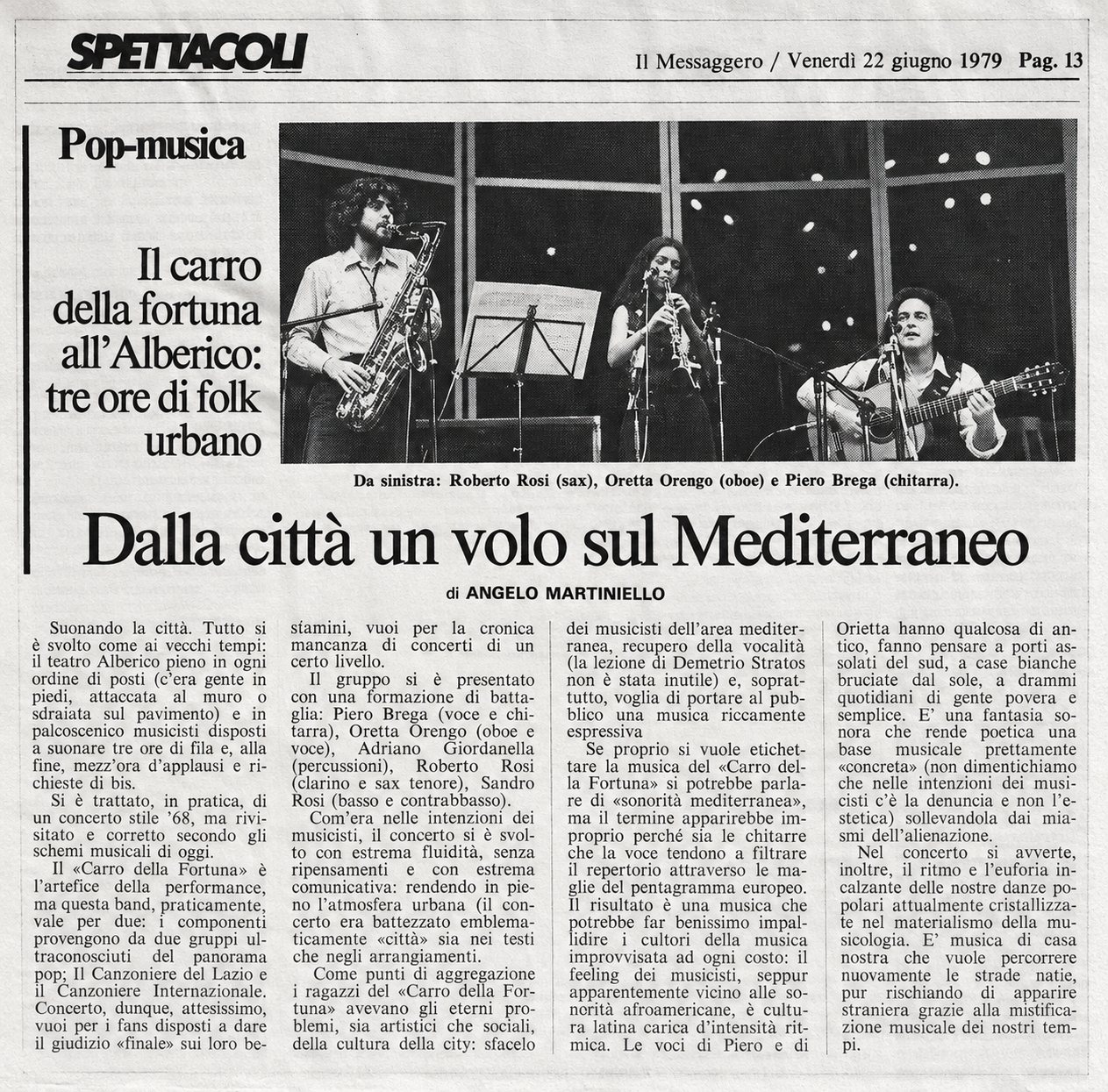
Il Messaggero, 22 June 1979: article on Il Carro della Fortuna at the Alberico, with Roberto Rosi on saxophone
Il Messaggero, 22 June 1979
Newspaper cutting of 1 June 1979: Giulio Capiozzo, drummer of Area, Roberto Rosi on saxophone and Oretta Orengo
1 June 1979: with Giulio Capiozzo, drummer of Area, and Oretta Orengo